

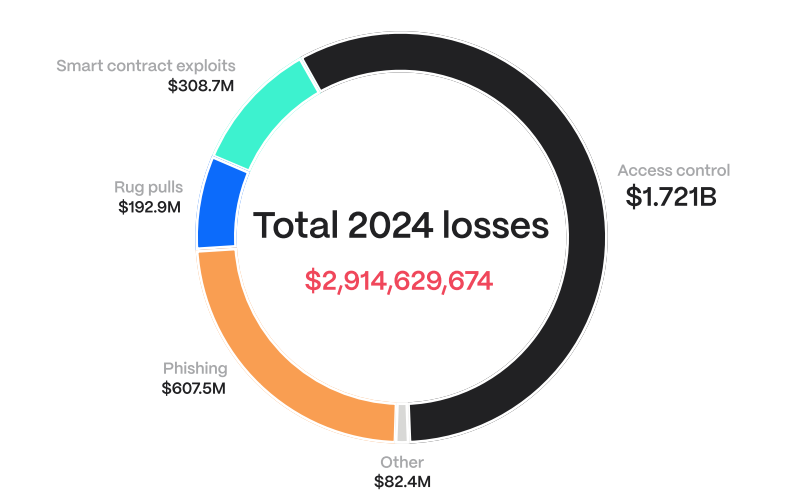
Crypto hacks caused losses of over $2.91 billion in 2024, highlighting ongoing vulnerabilities in blockchain security. However, overall losses were stable compared to 2023, according to a report by blockchain security firm Hacken.
Access Control Exploits:
Access control weaknesses were the primary cause of losses in centralized exchanges (CeFi), decentralized finance (DeFi), and gaming/metaverse platforms. Hackers exploited poor key management and operational security practices, resulting in $1.72 billion in losses. This marks a sharp increase from 50% of such incidents in 2023.
DeFi and CeFi Trends
- DeFi Sector: Losses in DeFi dropped significantly to a 40% reduction from 2023. Improved bridge security and adoption of advanced cryptographic techniques contributed to this decline. However, access control vulnerabilities continued to plague the sector, with 50% of DeFi losses stemming from such exploits.
- CeFi Sector: In contrast, CeFi platforms experienced increased losses, totalling $694 million. Centralized exchanges like DMM Bitcoin and WazirX faced major hacks, with combined losses exceeding $500 million.
Gaming and Metaverse platforms suffer heavy losses
Gaming and metaverse platforms accounted for 21% of the total losses, with access control vulnerabilities driving incidents like the $290 million PlayDapp hack. Hackers exploited weaknesses in token minting controls, causing significant financial damage and impacting user trust.
Improvements in Bridge Security
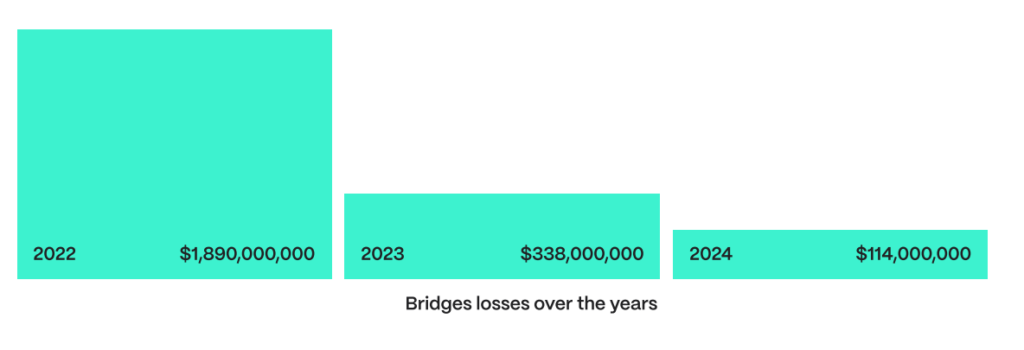
Bridge-related losses dropped dramatically to $114 million, down from $330 million in 2023 and $1.9 billion in 2022. This decline reflects better security practices, including multi-party computation and zero-knowledge cryptography, which have made cross-chain protocols more resilient.
Phishing Scams on the Rise
Phishing scams resulted in an additional $600 million in losses, with attackers using sophisticated techniques like address poisoning and fake airdrops to deceive users. One of the largest phishing attacks involved a $129 million theft on the Tron blockchain, where an attacker mimicked the victim’s wallet address to steal funds.
Major Hacks of 2024
- PlayDapp Hack (Gaming/Metaverse): In Q1, attackers exploited an access control vulnerability to mint unauthorized tokens, resulting in $290 million in losses.
- DMM Exchange Hack (CeFi): In Q2, compromised private keys led to the theft of $305 million worth of Bitcoin.
- Radiant Capital Hack (DeFi): Malware targeting developer devices enabled attackers to steal $55 million in Q4.
The report underscores the contrasting trends between DeFi and CeFi security in 2024. While DeFi platforms showed significant progress in reducing losses, centralized exchanges faced growing challenges. As the crypto ecosystem continues to evolve, experts emphasize the importance of robust security measures across all sectors to protect users and prevent further losses.
Also, check out, Singapore approves 13 Crypto Licenses in 2024
Do visit CoinTopper for more such content.